
Last updated: October 15, 2026
American ginseng, 花旗蔘 and 西洋蔘 are three names for the same plant, Panax quinquefolius. Asian ginseng, often just called 人蔘 in Chinese, is a different species, Panax ginseng. The two Chinese names come from old words for foreign places. 花旗, "flower flag", was the name people in Canton gave the American flag, and 西洋 is an old Chinese term for the West. "Canadian ginseng" is American ginseng grown in Canada.
Are American ginseng, 花旗蔘 and 西洋蔘 the same thing?
Yes. All three names refer to Panax quinquefolius, a plant native to the forests of eastern North America. A 2025 review of the plant's history in the Chinese journal Chinese Traditional and Herbal Drugs (中草藥) lists its other Chinese names as 西洋人蔘, 洋蔘, 美國人蔘, 花旗蔘 and 廣東蔘, all for the same species.
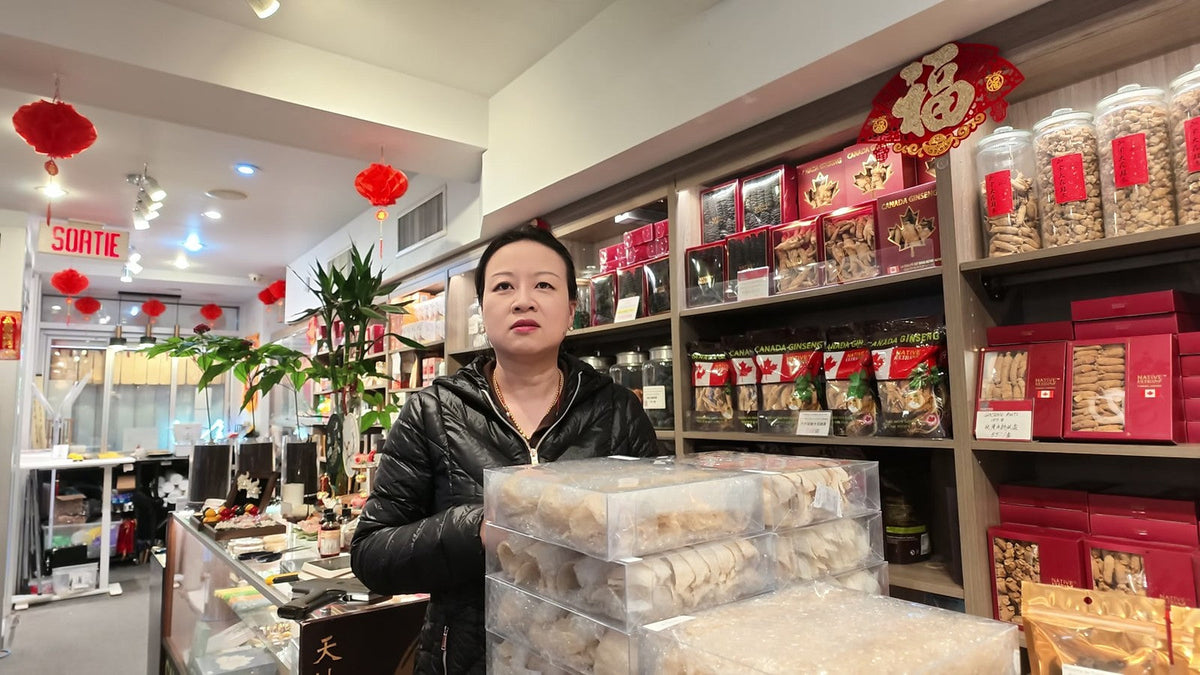
Carmen, who runs Fosetter, hears the question all the time. "A lot of people ask what the difference is between 西洋蔘 and 花旗蔘," she says in one of our shop videos. "They're the same family." She also points out that Cantonese speakers usually say 花旗蔘. In Cantonese it is pronounced faa kei sam. Mandarin speakers more often say 西洋蔘, xīyáng shēn.
Why is American ginseng called 花旗蔘?
The name goes back to the first American trading voyage to China. In 1784 the merchant ship Empress of China sailed from New York to Canton (Guangzhou) carrying a cargo of ginseng. People in Canton called the striped, starred flag on the ship 花旗, the "flower flag" (Wikipedia, Flag of the United States). The United States became 花旗國, the flower-flag country, a nickname that Cantonese dictionaries still list (Jyut Dictionary, 花旗國). Ginseng from that country became 花旗蔘.
Carmen explains it the same way. "Why is it called 花旗蔘? Because it's from America, and America is called 花旗國."
Why is it also called 西洋蔘?
西洋 means "the Western seas". In the Ming dynasty the word covered the lands Chinese fleets reached by sailing west, from Southeast Asia to the Indian Ocean. Over time it came to mean Europe and the Western world in general, which is how it is used today (Chinese Wikipedia, 西洋). So 西洋蔘 simply means ginseng from the West, the same way 花旗蔘 means ginseng from America.
The root reached China in the early 18th century as an imported medicine. Qing dynasty herbal books recorded it as coming from France, and in 1757 Wu Yiluo's Bencao Congxin (本草從新) listed it under the name 西洋人蔘. The 2025 review notes that because it arrived as an import, Qing writers were often unclear about where it actually grew.
The France connection makes sense once you know the Montreal side of the story. In 1716 the Jesuit missionary Joseph-François Lafitau found American ginseng near Kahnawà:ke, just south of Montreal (Dictionary of Canadian Biography). Ginseng from New France was later shipped to China by way of La Rochelle, especially between 1747 and 1752 (Canadian Museum of History). Some of the "Western ginseng" that reached China in the 18th century grew around here and travelled on French ships.
What is the difference between American ginseng and Asian ginseng?
They are two species in the same genus, Panax. Asian ginseng (Panax ginseng) is native to the mountains of Northeast China, the Korean Peninsula and the Russian Far East, and is also known as Korean ginseng or Chinese ginseng (Wikipedia, Panax ginseng). In Chinese it is usually just 人蔘, and Korean roots are often sold as 高麗蔘. The Government of Ontario says Panax quinquefolius, the species grown in North America, "differs slightly from the principal species native to Asia, Panax ginseng" (Ontario.ca, Ginseng production).
Traditional Chinese medicine also treats them as separate herbs. Qing dynasty texts already described 西洋蔘 as different from Jilin and Korean ginseng, classing American ginseng as cooling and Asian ginseng as warming, according to the 2025 review.
What is Canadian ginseng?
Canadian ginseng is American ginseng grown in Canada. It is the same species, Panax quinquefolius. In Canada, wild American ginseng is found only in southern Ontario and Quebec, and only cultivated ginseng can be legally traded (Government of Canada). Commercial growing is centred in Ontario, where the Ontario Ginseng Growers Association says its more than 150 growers have the largest production of North American ginseng in the world (ginsengontario.com).
So a bag labelled "Canada Ginseng" with a price tag that says 花旗蔘, which you will see on our own shelves, is not a contradiction. The species is American ginseng, the old Chinese name points to America, and the farm is in Ontario. Read more on our Discover Canadian Ginseng page.
Does the name tell you where the ginseng was grown?
No. 花旗蔘 and 西洋蔘 name the species. Ginseng sold under either name can be grown in the United States, in Canada or in China, which the 2025 review describes as the third-largest producer after the United States and Canada. To know where a root was grown, you need the label, the documents and an honest seller. Our guide on how to buy authentic Canadian American ginseng explains what to check.
Quick answers
Is 花旗蔘 the same as 西洋蔘? Yes. Both are American ginseng, Panax quinquefolius.
What does 花旗 mean? "Flower flag", the old Cantonese name for the American flag.
What does 西洋 mean? The West. It is an old Chinese term for Europe and the Western world.
Is Canadian ginseng a different kind of ginseng? No. It is American ginseng grown in Canada.
Is 高麗蔘 the same as 花旗蔘? No. 高麗蔘 is Asian ginseng, Panax ginseng.
See our NATIVE ULTRA Canadian ginseng or the Ginseng FAQ for more.
Sources
- Chen Jian et al. (2025), 西洋參本草考證及其現代研究進展, Chinese Traditional and Herbal Drugs 56(19)
- Wikipedia, Flag of the United States
- Jyut Dictionary, 花旗國
- Chinese Wikipedia, 西洋
- Dictionary of Canadian Biography, Joseph-François Lafitau
- Canadian Museum of History, Virtual Museum of New France, Health and Medicine
- Wikipedia, Panax ginseng
- Government of Ontario, Ginseng production
- Government of Canada, American ginseng
- Ontario Ginseng Growers Association


Dejar un comentario
Este sitio está protegido por hCaptcha y se aplican la Política de privacidad de hCaptcha y los Términos del servicio.