
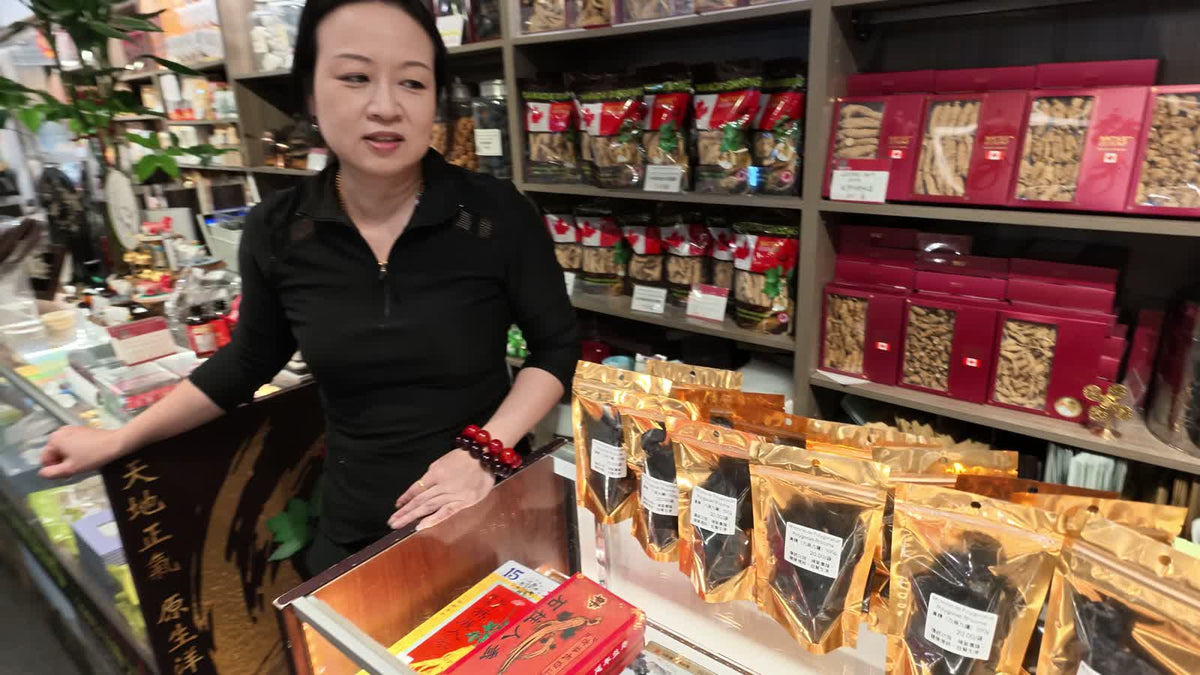
"I thought it was the root of some plant, 'jin' as in gold?" Carmen remembers asking. "No, it's really called huangjing," she says, holding up the dark, dense root at the Fosetter counter. The name sounds close to "huangjin," gold, but it isn't gold at all.
Fresh root is pale yellow. Properly processed, it turns black.
Dug straight out of the ground, huangjing's root is yellowish, its natural, unprocessed color. Getting it ready to sell takes repeated rounds of steaming and sun-drying. "Once it's processed, it really does turn black," Carmen says.
The color tells you how many cycles it went through
This is the part Carmen checks for herself: the color is a direct readout of how many times the root has actually been steamed and sun-dried. "After it's processed, you really need nine steams and nine sun-dries," she says. Skip steps and the color stays lighter. "If it's only gone through three steams and three sun-dries, or fewer than four cycles, the color won't look like this. It stays more yellow."
So a huangjing that's still noticeably yellow after processing hasn't been through the full cycle. A properly finished one should be dark, close to black.
Wild roots exist, but they're harder to get
"Wild ones exist too," Carmen says, "but harvesting them is a lot more work." Most of what's sold commercially is cultivated rather than wild-harvested, for exactly that reason.
Fosetter stocks the fully processed huangjing, the kind that's been through its full nine steams and nine sun-dries, not a shortcut version. Carmen's own check, before anyone asks, is simply to look at the color.


Dejar un comentario
Este sitio está protegido por hCaptcha y se aplican la Política de privacidad de hCaptcha y los Términos del servicio.