
Last updated: October 15, 2026
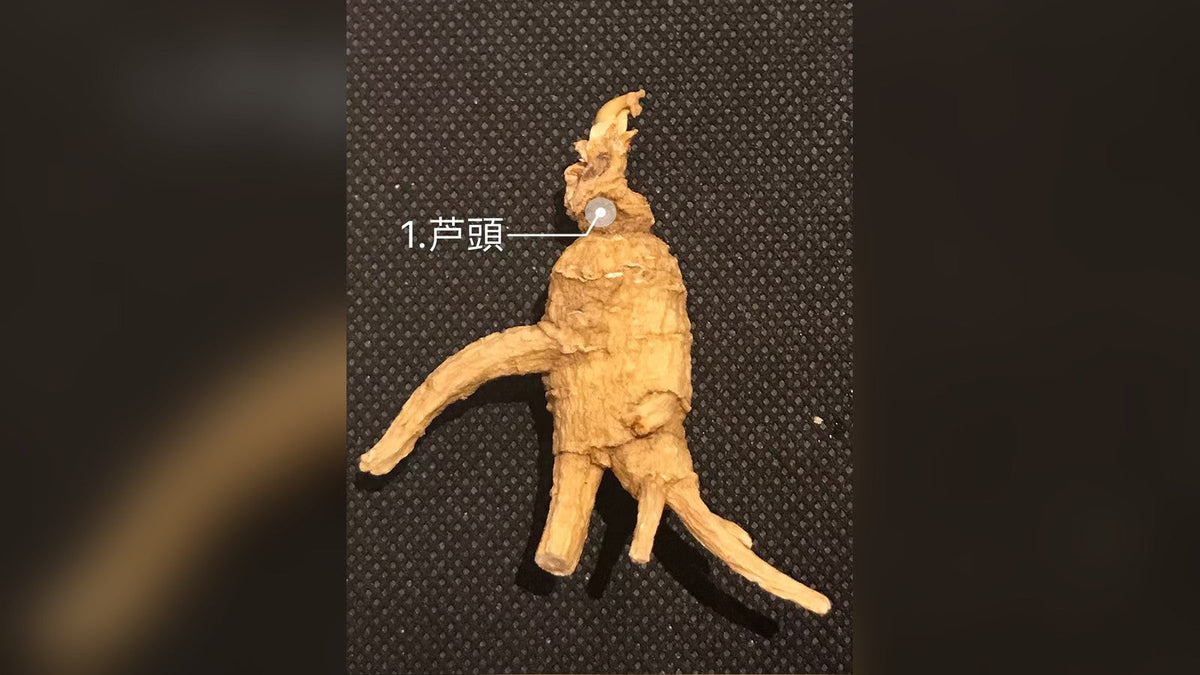
You can estimate the age of a ginseng root by counting the scars on its neck, the short knobby piece at the top of the root. The plant leaves one scar there each autumn when its stem dies back. The first year leaves no scar, so the number of scars plus one gives a rough age. A root with four scars is about five years old. Treat the result as an estimate. Scars can be hard to read, and if the neck has broken off, the record goes with it.
What is the neck of a ginseng root?
American ginseng (Panax quinquefolius) keeps its true stem underground. This short underground stem is called the rhizome. It sits on top of the main root, and buyers usually call it the neck. In Chinese it is called 蘆頭. During each growing season the rhizome forms a bud, and that bud becomes the next year's leafy plant above ground (Wild American Ginseng, plant biology, with a diagram credited to E. P. Burkhart of Penn State and J. B. McGraw of West Virginia University).
Why does a ginseng root get one scar per year?
In autumn the leaves and stem above ground wither and fall away. The spot where the stem was attached stays on the rhizome as a small scar. The U.S. Fish and Wildlife Service describes it this way: "Each year of growth adds a stem scar to the root neck when the leaf stem dies back in the autumn." The next spring a new stem grows from the bud, and the next autumn it leaves another scar. Over the years the neck turns into a short column of these marks.
How do you count the scars on a ginseng neck?
- Find the neck at the top of the root, above the point where the body of the root begins.
- Look for the small dents along it. Each dent marks a place where a stem once grew. Good light and a magnifying glass help.
- Count the dents from the bottom of the neck to the top.
- Add one for the first year, which leaves no scar.
The Fish and Wildlife Service puts the rule in numbers. A 5-year-old plant will have 4 stem scars on the root neck, and a 10-year-old plant will have 9. In the United States, inspectors count these scars to check that wild roots meet the legal minimum age before they can be exported, which is why harvesters are told to keep the neck attached (USFWS fact sheet).
Carmen, who runs Fosetter, counts them the same way in one of our shop videos. Pointing at the dents on the neck, she says, "One dent is one year," and counts up to six.
Is counting scars an exact way to tell a ginseng root's age?
No. It is a rule of thumb. Iowa State University's extension guide on ginseng says aging ginseng "can be difficult," and that it takes practice to get good at counting the scars. Scars that sit close together can blur into one, old scars wear down, and the neck can be damaged when the root is dug, washed or dried. A careful count gets you close to the real age. It does not give you a certificate.
Carmen handles that uncertainty in the simplest way. After counting six dents on one root, she said, "It might be six years old, but we sell it as five."
What do "4-year", "5-year" and "6-year" mean on ginseng products?
On cultivated ginseng, the age describes how many years the root grew in the field before harvest. The Government of Ontario says field-grown ginseng is harvested 3 to 5 years after seeding (Ontario.ca, Ginseng production). A root that stays in the ground longer has more time to grow, and price usually rises with age and size.
Our NATIVE ULTRA Canadian ginseng comes in several ages.
- 4-year whole roots, in regular and small sizes
- 5-year premium whole roots
- 6-year selected whole roots
- 5-year slices
On a whole root you can check the label yourself by counting the neck. Slices and powder have no neck left to count, so for those products the age comes from the seller and the supplier. That is one more reason to buy from a shop you can ask questions in person.
Can the neck tell you where ginseng was grown?
The neck tells you roughly how long a root grew. It does not prove which country or farm it came from. For origin, look at the paperwork, the grower association logo and the seller. Our guide on how to buy authentic Canadian American ginseng explains what to check, and Discover Canadian Ginseng covers where it is grown in Ontario.
Quick answers
How many scars does a 5-year ginseng root have? About four. The first year leaves no scar.
What is 蘆頭? The Chinese name for the neck, or rhizome, at the top of a ginseng root.
Can I tell the age of sliced ginseng? Not by looking. Slices have no neck, so ask the seller.
Is a scar count exact? No. It is a close estimate, and an experienced eye makes it closer.
More questions are answered on our Ginseng FAQ page.


Leave a comment
This site is protected by hCaptcha and the hCaptcha Privacy Policy and Terms of Service apply.