
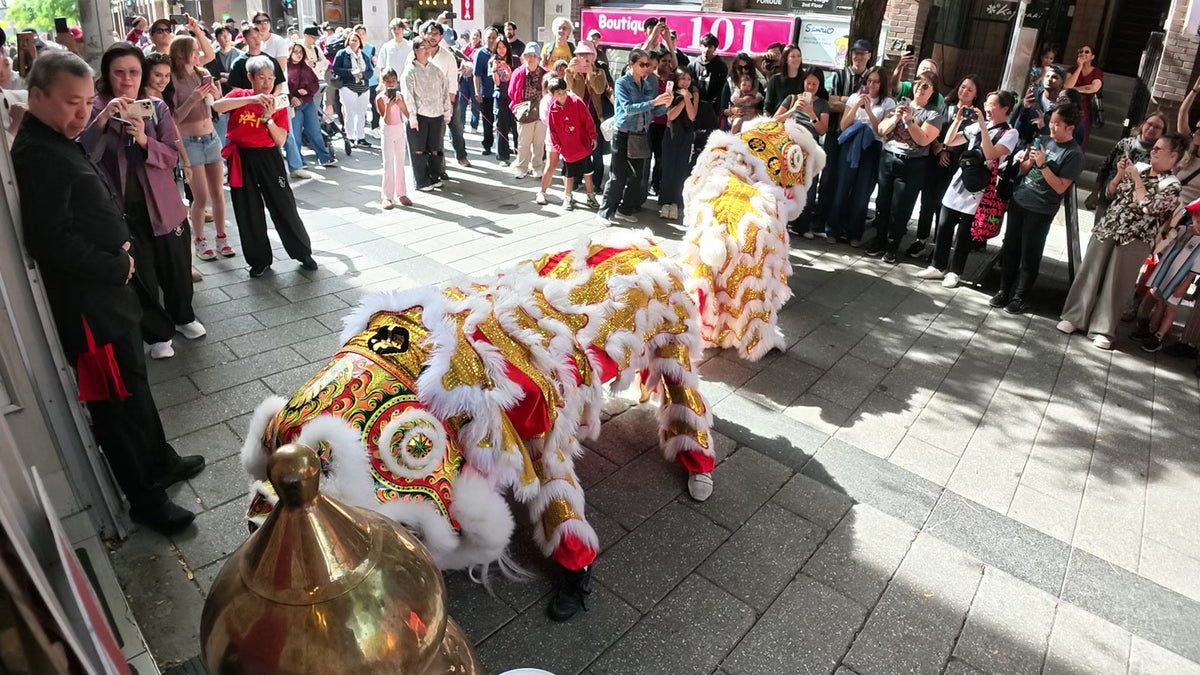
On September 26, 2026, a lion dance team started its afternoon at our door on Rue De La Gauchetière and worked its way through Montreal's Chinatown. Visitors kept asking the same thing. Why does the lion eat a head of lettuce? Here is the answer, step by step.
What you see on the street
Two lions, a drum, cymbals and a gong. The lions come up to a shop, dance around the doorway, and then go for a head of lettuce hung up high or set out by the door. A red envelope is tied to the lettuce. The lion "eats" the greens and takes the envelope at the same time, and the shop gets a wish for good fortune in return.
That moment has a name. In Chinese it is 採青, cai qing, which means "plucking the greens." It is a regular part of the southern lion dance and usually the high point of the show.
Why lettuce?
It comes down to sound. In Cantonese, the word for lettuce, 生菜, sounds almost the same as 生財, "to grow wealth." Only the tone is different. So when the lion takes the lettuce, the shop is receiving a wish for its business to grow.
The name of the custom carries a second pun. 採 (to pluck), 菜 (vegetable) and 財 (fortune) all sound alike in Chinese, so "plucking the greens" also sounds like "gathering fortune."
The red envelope
The red envelope is called 利是, lai see in Cantonese. The word comes from the New Year greeting 利利是是, a wish for good luck and profit. In a lion dance, the envelope also goes to the troupe as thanks for the performance. The team keeps it, and the shop keeps the luck.
A show in three steps
A full performance usually follows three parts.
- 旺場, bringing in the luck. The lion goes around the space so that good fortune reaches every corner.
- 採青, plucking the greens. The lion reaches or leaps for the lettuce and the red envelope.
- 獻寶, presenting the treasure. The lion shakes its head and scatters the torn lettuce leaves, sometimes with orange peel, all around. The scattered leaves stand for wealth landing everywhere, and people often pick them up for luck.
So if a few lettuce leaves land on you, you are standing in a good spot.
About the lion itself
The lions you see in Montreal's Chinatown are southern lions, the style that comes from Guangdong. It is the best known lion dance outside China. You can spot it by the single horn on the forehead. The head is traditionally built on a bamboo frame, covered with papier-mâché and gauze, then painted and trimmed with fur.
Lion dance is also closely tied to kung fu. Many of its basic moves come from martial arts, and teams are often part of a kung fu school. That is why the same people who carry the lion often put on a kung fu demonstration on the same day.
What it looked like at our door
On September 26, the team set up right in front of the shop. The lion heads sat on the sidewalk, the drum was rolled into place, and a table by the door held a pair of golden gourds. The crowd filled the street in a half circle, almost everyone holding up a phone.
From our door the lions went on, shop by shop, the same dance and the same greens each time. Each stop left another shop with a wish for good business.
We have a personal reason to love this tradition. Carmen's daughter Wendy dances with the team. You can read how she joined, and what Carmen says about the day.
Fosetter is at 78 Rue De La Gauchetière Ouest, in the heart of Montreal's Chinatown. Come by when the lions are out, or any other day. More about our shop.


コメントを書く
このサイトはhCaptchaによって保護されており、hCaptchaプライバシーポリシーおよび利用規約が適用されます。