
Last updated: October 15, 2026
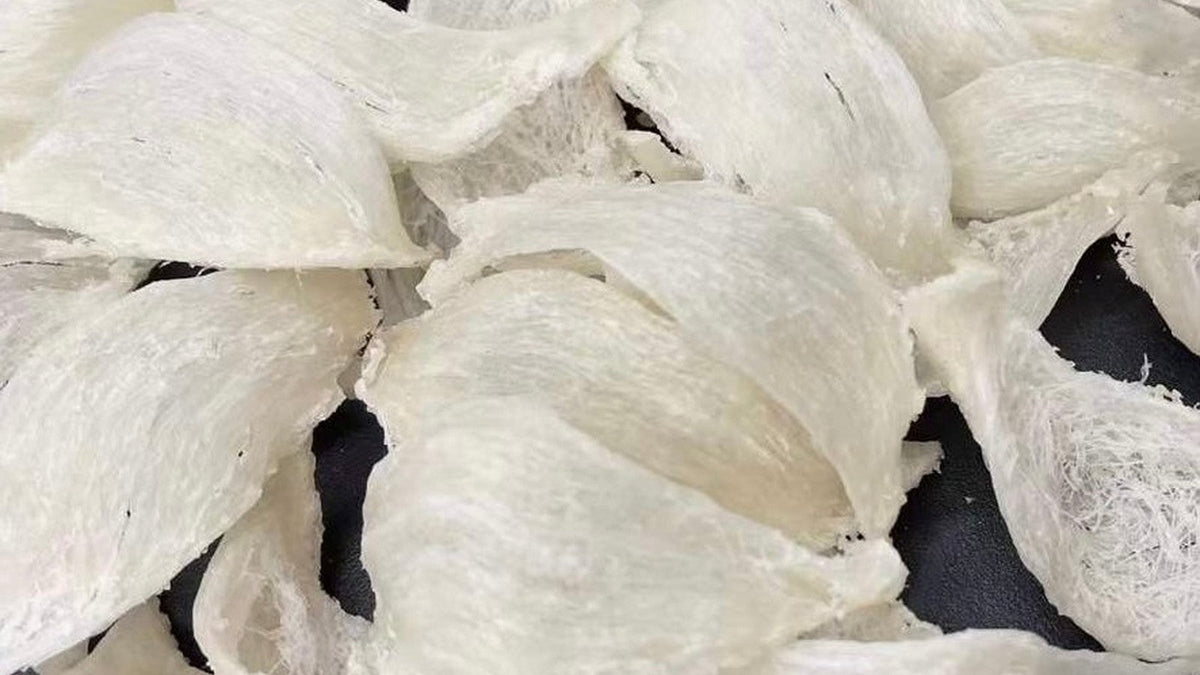
Bird's nest fragments are real swiftlet nest. They are the small pieces that break off while the nests are cleaned, picked and dried, and they cost less than whole cups because they have lost their shape. Bird's nest is graded mainly by how complete it is, from whole cups down to strips, corners and fragments. Whatever the grade, the checks for a good nest stay the same, and this guide covers what Carmen looks at when a new batch arrives at our shop.
What is edible bird's nest?
Edible bird's nest is the nest that certain swiftlets build from their own saliva, which hardens as it dries. A 2021 review in Frontiers in Pharmacology names the two main commercial species as Aerodramus fuciphagus, the white-nest swiftlet, and Aerodramus maximus, the black-nest swiftlet. Most of it comes from Southeast Asia, including Indonesia, Malaysia and Thailand. Raw nests contain feathers and other debris, so before sale they are soaked, picked clean by hand, shaped, dried and graded.
How is bird's nest graded?
The main grading is by shape and completeness. Colour and the swiftlet species also affect the grade. The same review lists the forms of cleaned nest as follows.
- Cup (燕盞). A nest that keeps most of its original half-cup shape. This is the top grade by appearance and the most expensive.
- Corner (燕角). The two hard ends of the cup where the nest was attached to the wall. Corners are dense and usually need a longer soak.
- Strip (燕條). Longer pieces that broke off a cup but still hold a strip shape.
- Fragment (燕碎). The smaller pieces collected after processing and packed together.
- Cake. Fragments pressed into a mould, often a round biscuit shape.
Some sellers add finer steps in between, such as thin threads (燕絲). The names vary from shop to shop. The order from whole to broken does not.
Why are fragments cheaper than whole cups?
A whole cup has to survive soaking, feather picking, shaping and drying without breaking, and buyers pay for that. The pieces that break along the way are the same nest, but they can no longer be sold as cups, so they are sold by weight as strips or fragments at a lower price. If you are cooking the nest at home and nobody will see its shape, fragments and strips are the usual way to spend less.
Fragments can also be pressed into moulds of any shape, so the shape tells you little about a cake or a pressed piece. Researchers have found nests adulterated with things like white fungus, fish swim bladder, jelly and egg white, and white nests dyed red to sell as a pricier colour. That is a reason to buy from a seller who checks each batch, whatever the grade.
What does Carmen check when she buys bird's nest?
Carmen looks at every batch before it goes on the shelf, and she soaks a few pieces herself to see how they behave before she tells customers how to prepare them. These are the things she checks.
- Natural colour. A good nest keeps its own colour, with nothing added on the surface.
- No shine. Carmen says a natural nest does not reflect light. Nests brushed with glue do.
- Visible texture. Held up to the light, a good nest shows clear strands and layers. On poor nests the texture is blurred, and pieces look stuck together, especially at the thick parts.
- Nothing stuck to the base. Carmen has seen nests with lots of loose fragments glued onto the base. On a clean nest, the base has nothing extra attached.
- Dryness. She feels the nest by hand. A well-dried nest feels dry and light, not soft or damp.
- Soaking time. Carmen says a good nest softens after 2 to 4 hours of soaking. Glued pieces fall apart if they are stewed too long and turn to water, with none of the body a real nest has.
She keeps a box of these poor nests that is not for sale. She uses it to show customers the difference side by side, next to a clean nest with clear texture and a clean base.
How do you prepare bird's nest at home?
Soak it in clean cold water until it is soft, then drain it. Carmen's guide is 2 to 4 hours of soaking for a good nest. Corners take longer. For white nest, she stews it for 35 to 40 minutes. Ask us when you buy, since the right time depends on the grade and the batch.
Which grades does Fosetter sell?
We carry whole cups in several sizes and brands, plus natural bird's nest strips and natural bird's nest fragments in 50 g bottles. At the counter, Carmen also has triangle nests (三角燕) from Indonesia, which she says grow against the wall and have a thicker body. You can see the full range on our bird's nest page, or come to 78 Rue De La Gauchetière Ouest in Montreal's Chinatown and compare the grades in person.
Quick answers
Are bird's nest fragments real bird's nest? Yes. They are pieces that broke off during cleaning and processing.
Is a whole cup better than fragments? A cup is the higher grade by appearance and costs more. If the shape does not matter for your cooking, fragments or strips cost less.
How can I spot a glued nest? Carmen looks for shine, blurred texture, and fragments stuck onto the base, and checks how it holds up when soaked and stewed.
Can I see the difference before buying? Yes. Ask Carmen at the shop and she will show you.


tin nhắn
Trang web này được bảo vệ bằng hCaptcha. Ngoài ra, cũng áp dụng Chính sách quyền riêng tư và Điều khoản dịch vụ của hCaptcha.