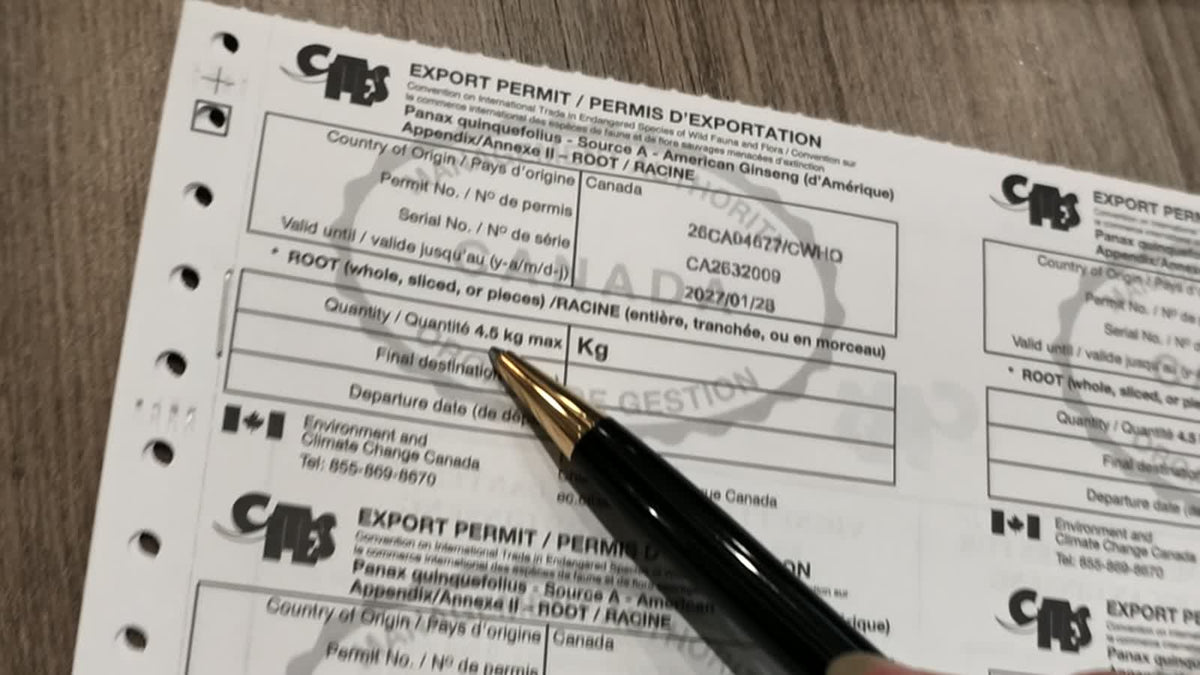
"This is the small permit, the one for travellers," Carmen says, pointing at a stack of CITES forms on the counter at Fosetter. "One person can take 4.5 kilograms, it says 4.5 kilograms maximum right on it." She breaks the number down further: that's about ten one-pound bags of American ginseng, since each bag runs 454 grams. Here is what she walked us through about the paperwork behind every shipment that leaves the store.
A permit renewed every six months
"This is the American ginseng export permit. It has to be renewed every six months, and the paperwork has to be done very, very carefully," Carmen says. Fosetter has to show that its ginseng comes from a qualified farm registered with the Ontario Ginseng Growers Association, and back that up with proof of origin. "This export permit isn't for one country's customs. It's recognized by customs in any country, because everyone takes CITES seriously," she says, referring to the international convention that protects American ginseng as a species. For the general rules on bringing ginseng across the border, see our guide on where Fosetter's ginseng is grown.
When it becomes a commercial permit
The small traveller's permit has a ceiling. "Because we're also in the trade business, if we're shipping more than ten kilograms of American ginseng to another country, or a ton or two tons, then we need the commercial export permit," Carmen says. "Not everyone has one of those."
Why it has to go by courier, not the post office
Every shipment carries its own paperwork trail. "There's the AWB on the package, the invoice, the commercial invoice, the packing list, all three together," she says. "You bring those to customs, and here in Canada, when it goes out, they stamp it, and the customs officer signs it, and only then does it leave. So the work has to be very thorough." That also rules out one common shortcut. "It can't go through the post office. It has to be DHL, UPS, something like that, because they have their own independent customs clearance ability. That's the only way it works."
Why the boxes aren't for sale
Even Fosetter's own packaging is part of the paper trail. "Every one of our packages has our own address and phone number on it, because if someone looks it up, those numbers have to match, have to correspond," Carmen says. "That's why we can't give our packaging to someone else, or lend it out, and we can't use our packaging to pack someone else's American ginseng. We don't sell it. We've had customers offer us a lot of money for our packaging, and we still don't sell it. Because we have to be responsible, and that's a responsibility we can't afford to drop."
You can see the actual CITES permit paperwork at the Fosetter counter, 78 Rue De La Gauchetière Ouest in Montreal's Chinatown. For what the 4.5 kg traveller's limit means if you're flying out with ginseng, see our page on travelling with ginseng.


tin nhắn
Trang web này được bảo vệ bằng hCaptcha. Ngoài ra, cũng áp dụng Chính sách quyền riêng tư và Điều khoản dịch vụ của hCaptcha.