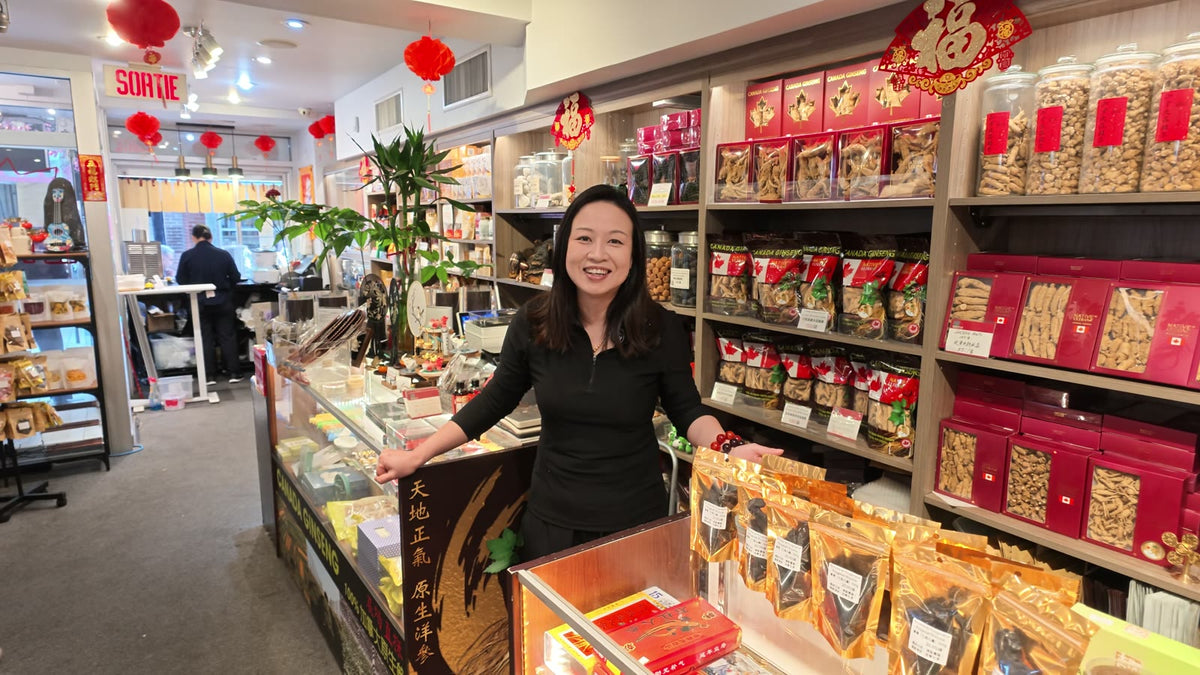
When people think of Canadian ginseng, they usually think of Ontario. Carmen, who runs Fosetter in Montreal's Chinatown, has a different answer for her own city. "Actually, the place of origin should be Montreal," she says. "It just went to Ontario to settle down, and that's where it really took off."
The certificate on the wall
Carmen starts with the paperwork. "This one is the certificate of origin," she says, pointing to the framed documents in the shop. "Everything we sell is genuine, and the quality is really good." The certificate has to be renewed. "We renew it every year."
She also points out that ginseng for export is held to a stricter standard. "Domestic and export are different. Export has stricter inspection." If you want to know what the Ontario growers' association behind these papers is, our post on what OGGA is explains it.
Six-year roots are getting rare
Then she reaches for the shelf. "These are all six-year American ginseng," she says. "In Ontario, six-year farms should be very rare now. These days it's mostly four or five years." She holds up the next box. "This is five years. In our shop it's mostly five-year roots."
That matches what the Government of Ontario says about how the crop is grown. In field cultivation, the root is harvested three to five years after seeding (Ontario.ca, Ginseng production). A six-year root has stayed in the ground longer than most. Our guide to telling a root's age shows what to look at.
Why Quebec, and why Ontario
"Actually, Quebec is where it started," Carmen says. In her telling, Quebec has a good setting and a good climate, but the soil did not cooperate. The ground here is harder, so the roots did not come out as well. "They went to Ontario to grow it, and in Ontario it really flourished."
She did not take this on faith. "When I went back to China, a doctor of Chinese medicine looked into it for me and gave me some documents and research," she says. "That's when I found out. Maybe here is the real hometown of American ginseng."
What the history books say
The record backs her up. Around 1715 to 1716, the Jesuit missionary Joseph-François Lafitau, stationed at Sault-Saint-Louis (Kahnawake) just south of Montreal, read a letter from Father Pierre Jartoux describing Asian ginseng in China. A Mohawk woman he hired recognized the plant, and he found American ginseng growing near the mission. According to the Dictionary of Canadian Biography, his 1718 publication set off a rush of collecting that nearly wiped the wild plant out of the St Lawrence valley.
Today, wild American ginseng in Canada is found only in southern Ontario and Quebec (Government of Canada). In Ontario, field cultivation began in the late 1800s, when growers moved wild roots into protected gardens, and the province says the climate and soils of south-central Ontario are ideally suited to the crop (Ontario.ca). So the plant was first recorded here, and the farms grew up there.
For more on how the names 花旗蔘 and 西洋蔘 came about, read American ginseng names explained.
Come see the shelf
The six-year and five-year roots Carmen talks about are on the shelf at 78 Rue De La Gauchetière Ouest. You can also browse our NATIVE ULTRA Canadian ginseng online, or read more on Discover Canadian Ginseng.


Leave a comment
This site is protected by hCaptcha and the hCaptcha Privacy Policy and Terms of Service apply.